Standing Desks Aren't the Answer — They're Just a Different Problem
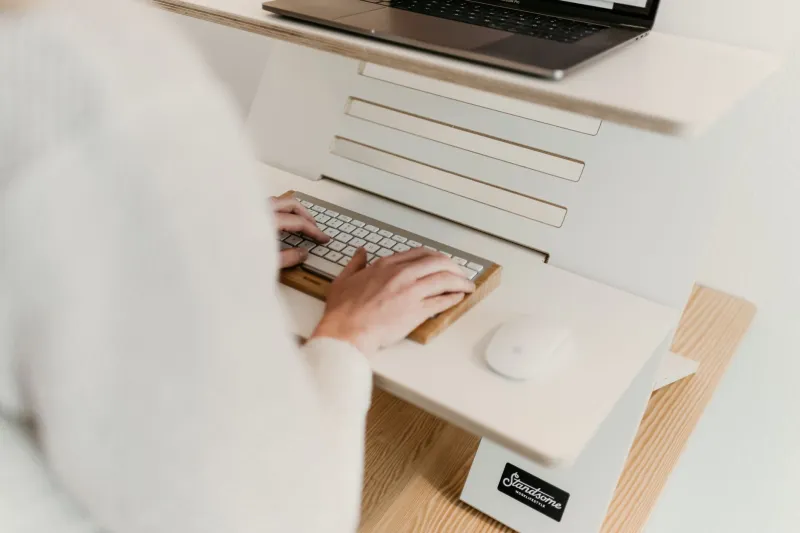
Somewhere around 2015, the standing desk became the office wellness symbol of the decade. Open-plan offices started filling up with height-adjustable workstations, and people convinced themselves that trading their chairs for a standing platform was basically the same as going to the gym. The marketing was compelling. The logic seemed airtight. Sitting is killing you, so... don't sit.
Except the research didn't quite cooperate.
Studies tracking workers who switched to standing desks found something inconvenient: prolonged static standing carries its own laundry list of physical consequences — lower back pain, leg fatigue, varicose veins, swollen ankles, and even increased cardiovascular strain. One study out of Canada found that workers who stood for most of the day were nearly twice as likely to report musculoskeletal pain as those who sat. That's not a ringing endorsement for the $800 motorized desk you just financed.
So what's actually going on here — and more importantly, what should desk workers actually be doing?
Your Body Wasn't Built for Any Single Position
Here's the core issue that most standing desk marketing conveniently glosses over: the human body is designed for movement variety, not positional optimization. Whether you're parked in a chair or planted on your feet, sustained static loading — holding any position for extended periods — creates mechanical stress that your tissues aren't designed to absorb indefinitely.
When you sit for hours, your hip flexors shorten, your glutes go quiet, and the compressive load on your lumbar discs climbs steadily. When you stand for hours, the load shifts — but it doesn't disappear. Your posterior chain fatigues, your lumbar curve often hyperextends, and the muscles of your lower legs work overtime just to keep blood from pooling. Neither scenario is what your body was built for.
What your musculoskeletal system actually craves is variety. Alternating loads. Different joint angles. Frequent low-level movement that keeps circulation moving, tissues hydrated, and your nervous system engaged. A standing desk, used the way most people use it — standing statically for long stretches — just trades one form of postural monotony for another.
The Problem With "Just Stand More"
The advice to simply stand more sounds reasonable on the surface, but it misses the mechanism behind why prolonged sitting is harmful in the first place. The damage from desk work isn't purely about being in a seated position — it's about the absence of movement signals that your body relies on to regulate everything from blood sugar to spinal disc nutrition.
Your intervertebral discs, for instance, don't have a direct blood supply. They get their nutrients through a process called imbibition — essentially, they absorb fluid when load is applied and released cyclically. That only happens when you move. Static standing doesn't deliver that. Neither does static sitting. What does? Changing positions regularly, walking, and integrating the kind of low-grade movement that keeps that fluid exchange happening throughout the day.
There's also the neuromuscular piece. When you hold any fixed posture long enough, your brain starts tuning out the sensory signals from the muscles supporting that position. That's partly why you stop noticing how hunched your shoulders have gotten by 3 p.m. — your nervous system has essentially put those signals on mute. Movement variety keeps those feedback loops active.
What a Smarter Workday Actually Looks Like
Instead of framing this as a sitting-versus-standing debate, think of your workday as a movement portfolio. The goal is diversification — spreading postural load across multiple positions and incorporating enough transition and micro-movement that no single tissue gets hammered continuously.
Here's a practical framework that doesn't require a fancy desk or a fitness tracker subscription:
The 20-8-2 Rule For every 30-minute block, aim for roughly 20 minutes seated, 8 minutes standing, and 2 minutes of active movement — a short walk, some light stretching, a few bodyweight squats. This rhythm keeps positional variety built into your day without requiring you to constantly watch the clock.
Use Your Transitions Intentionally Every time you shift from sitting to standing (or vice versa), treat it as a movement opportunity rather than just a position swap. Do a hip hinge, a standing hip flexor stretch, a few calf raises. These micro-movements take under 60 seconds and collectively add up to meaningful tissue loading variety across a full workday.
Floor Sitting Deserves a Spot in Your Rotation This one surprises people. Spending even 10–15 minutes in a floor-seated position — cross-legged, in a low squat, or in a half-kneeling position — loads your hips and ankles through ranges that chairs and standing desks completely ignore. Many physical therapists note that populations who regularly rest in floor positions maintain hip mobility well into older age. Your carpet is underrated.
Walk Your Calls This is one of the highest-leverage habits available to desk workers. If you're on a phone or audio-only meeting, walk. Even a slow indoor pace — around the office, up and down a hallway — delivers enough movement stimulus to meaningfully break up sedentary time. Twenty minutes of walking calls per day adds up to nearly two hours of light activity across a work week.
Rethink Your Chair Setup If you're going to sit — and you will — make the chair work better for you. A seat height that allows your feet to rest flat on the floor, a slight forward tilt (either through a wedge cushion or a saddle-style chair), and periodic deliberate posture resets do more for your back than most ergonomic accessories marketed to office workers.
The Standing Desk Isn't Useless — It's Just Misused
To be fair, a height-adjustable desk is still a useful tool. The problem isn't the desk — it's the way people use it. Most standing desk owners essentially just swap their sitting hours for standing hours, which is a lateral move at best. Used as a tool for frequent position switching rather than extended standing, an adjustable desk earns its keep.
If you have one, try capping your standing intervals at 30–45 minutes maximum before transitioning. Add an anti-fatigue mat to reduce compressive load on your feet and lower back. And resist the urge to treat standing as the "healthy" mode and sitting as the "bad" mode — that framing is what gets people into trouble.
Movement Is the Medicine, Not the Position
At Live Healthy Wellness Centre, we talk a lot about moving better — and nowhere does that principle apply more practically than in the workday. The goal isn't to find the perfect desk setup. It's to build a day that keeps your body in motion, distributes load intelligently, and doesn't leave any single joint, muscle group, or tissue bearing the full burden of your 9-to-5.
Your standing desk might be a great starting point. But if it's just replacing one kind of stillness with another, you haven't solved the problem — you've redecorated it.