Scrolling Your Sensitivity Away: How Smartphone Habits Are Scrambling Your Body's Pain Signals

Your Body Speaks a Language Your Phone Is Slowly Erasing
You stub your toe, you feel it immediately. You hold a bad position for too long, your back starts complaining. That's your nervous system doing exactly what it's supposed to do — sending clear, accurate signals that something needs your attention. But what if that communication system started breaking down, and you didn't even notice?
That's exactly what researchers are beginning to understand about chronic smartphone use. It's not just your thumbs and neck taking the hit. Deep inside your nervous system, the feedback loops that govern pain perception, body position awareness, and movement quality are being quietly disrupted — one scroll at a time.
What Proprioception Actually Does for You
Before we get into the damage, let's talk about what we're working with. Proprioception is your body's internal GPS — the system of sensors in your muscles, joints, tendons, and skin that constantly feeds your brain information about where you are in space, how much tension you're carrying, and whether something hurts in a way that matters.
This system is extraordinarily precise when it's working well. It's what allows you to catch yourself when you stumble, feel the difference between productive muscle fatigue and joint pain, and adjust your movement patterns in real time during a workout. When it's compromised, you lose that edge. Movements become less efficient, minor injuries go unnoticed until they become major ones, and your performance quietly stagnates.
Here's the problem: proprioception requires active, varied sensory input to stay sharp. When your body spends hours locked into the same static posture — head forward, shoulders rounded, thumbs tapping — those sensors start tuning out. They're not getting the varied mechanical stimulation they need to stay calibrated.
Blue Light and the Nervous System: It's More Than Just Sleep
Most people have heard that blue light from screens messes with melatonin and sleep quality. That's real, and it matters. But the neurological disruption doesn't stop there.
Blue light exposure, especially in the evening hours, keeps your sympathetic nervous system — your fight-or-flight system — in a state of low-grade activation. When you're chronically running a little hot neurologically, your body's pain processing shifts. Research in neuroscience has shown that sustained sympathetic activation can alter the threshold at which you perceive pain, making some signals feel louder than they should while simultaneously dulling the subtler cues that would normally tip you off to a developing problem.
Think of it like trying to have a conversation at a concert. The obvious stuff — the loud, sharp stuff — still gets through. But the quiet, important information? That gets lost in the noise. You might not feel the early tightness in your hip flexor that's about to become a strain. You might not register the dull ache in your shoulder that's signaling impingement. But a sudden, acute pain? That cuts through just fine — usually right after something has already gone wrong.
The Posture-Perception Loop Nobody Talks About
Here's where it gets even more interesting. The forward head posture most people develop from phone use doesn't just create mechanical stress on the cervical spine — it actually changes how the brain maps your body.
Your brain is constantly updating its internal model of where your body parts are and how they move. When your head consistently sits two to three inches forward of where it should be, your brain starts treating that as the new normal. The sensors in your neck and upper back recalibrate. And when you try to move — whether that's in the gym, on a run, or just reaching for something overhead — your brain is working from a distorted map.
This is why so many active people feel "off" during workouts without being able to explain it. Their movement feels slightly wrong, their lifts feel uncoordinated, their balance seems shakier than it should be. The culprit often isn't weakness or flexibility — it's a nervous system that's been fed bad information for so long it's stopped trusting its own inputs.
Reclaiming Your Body's Signal Clarity
The good news is that the nervous system is remarkably adaptable. The same plasticity that allowed it to drift can work in reverse. Here are practical strategies that actually move the needle.
Build in screen-free sensory windows. Set aside at least 20 to 30 minutes before any workout where your phone stays put away. This isn't about willpower — it's about giving your nervous system a chance to downshift from sympathetic overdrive before you ask it to coordinate complex movement.
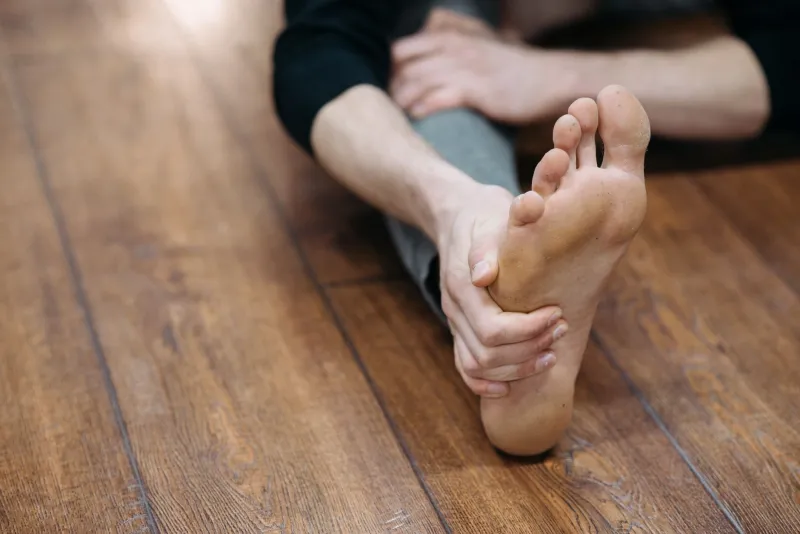
Train barefoot or in minimal footwear more often. Your feet are one of your richest sources of proprioceptive input. Even brief sessions of barefoot balance work, single-leg exercises, or mobility drills dramatically increases sensory feedback from the ground up. Your brain gets better information, and your movement quality responds accordingly.
Add deliberate slow movement to your warmup. Instead of rushing through a warmup, spend five minutes doing slow, intentional joint circles and controlled movement patterns. Moving slowly forces your nervous system to actually process what's happening rather than running on autopilot. It's recalibration in real time.
Practice body scanning during rest periods. Between sets, instead of reaching for your phone, do a quick internal check-in. Where do you feel tension? What's your breath doing? Is there anything pulling or aching that you hadn't noticed? This sounds simple, but it actively trains the interoceptive awareness that screen time erodes.
Prioritize blue light reduction after 8 PM. Use night mode settings, blue light glasses, or — better yet — actual screen-free time in the two hours before bed. You're not just protecting your sleep; you're allowing your nervous system to genuinely downregulate so it can process the day's physical demands and reset pain thresholds more accurately.
Incorporate contrast sensory work. Alternating between textures, temperatures, and surfaces during recovery — like walking on grass, using a foam roller, or doing cold-to-warm contrast therapy — gives your sensory system the variety it needs to stay sharp. Boredom is the enemy of a well-calibrated nervous system.
The Performance Angle Nobody's Selling You
Here's the thing the fitness industry doesn't talk about enough: body awareness is a performance variable. Athletes who accurately feel what their bodies are doing move more efficiently, recover smarter, and stay healthier over the long haul. That edge isn't built in the gym alone — it's built by keeping the communication lines between your body and brain clean and clear.
Your phone is a tool. An incredibly useful one. But it's also a constant sensory competitor, pulling your nervous system's attention away from the physical world your body actually lives in. Reclaiming your body's signal clarity doesn't require a digital detox retreat. It just requires a little more intentionality about when and how you let screens take over.
Move better. Feel more. And maybe put the phone down a little sooner than you planned tonight.