Breathe Like You Mean It: How Proper Breath Control Makes You a Stronger, Safer Lifter

You've dialed in your squat stance. You've watched seventeen tutorials on hip hinge mechanics. You've invested in decent shoes and a solid belt. But here's a question: what are you doing with your breath?
If your answer is "I don't know, just... breathing?" — you're not alone. Breath mechanics is one of the most consistently overlooked performance tools in strength training. And that's a shame, because fixing how you breathe during lifts might be the single fastest way to feel more stable, move more weight, and reduce your injury risk without changing a single thing about your programming.
Let's get into it.
Why Breathing Isn't Just About Oxygen
Most of us think of breathing as a simple gas exchange — oxygen in, carbon dioxide out. And sure, that's part of it. But when it comes to strength training, breathing serves a completely different mechanical purpose: it controls intra-abdominal pressure (IAP).
Here's the short version. Your core isn't just your abs. It's a pressurized canister — your diaphragm on top, your pelvic floor on the bottom, your abdominal muscles wrapping around the sides, and your deep back muscles completing the cylinder. When you breathe in and brace properly, you increase the pressure inside that canister. That pressure acts like a natural weightlifting belt, stiffening your spine and transferring force more efficiently from your lower body through your trunk and into the load you're moving.
When that system works well, you're stable, powerful, and protected. When it breaks down — when you're breathing haphazardly or holding your breath at the wrong moment — you lose spinal stability, force leaks out of the system, and your risk of injury goes up.
This is biomechanics, not bro science. Physical therapists, strength coaches, and sports scientists have studied IAP extensively, and the findings consistently point to the same conclusion: breath control is a foundational component of safe, effective lifting.
The Valsalva Maneuver: Your Spine's Best Friend (Used Correctly)
If you've spent any time around serious powerlifters, you've probably heard of the Valsalva maneuver. It sounds clinical, but the concept is simple: take a big breath into your belly, hold it, brace hard, and lift. This dramatically increases IAP and creates maximum spinal stiffness during the most demanding part of a movement.
For heavy compound lifts — squats, deadlifts, Romanian deadlifts, heavy rows — a controlled Valsalva is genuinely effective. Research supports its use in trained individuals for generating high force outputs while protecting the lumbar spine.
That said, a full Valsalva isn't appropriate for everyone in every context. People with cardiovascular conditions or high blood pressure should talk to their doctor before using this technique. And for lighter, higher-rep work, a modified breathing strategy tends to work better.
The General Rule: Exhale on Effort
For most people doing general fitness training — not competitive powerlifting — the most practical breathing cue is this: exhale on the hardest part of the movement.
This works because forceful exhalation naturally recruits your deep core muscles (particularly the transverse abdominis) and coordinates with your diaphragm to generate tension throughout the trunk. It's not as extreme as a Valsalva, but it's significantly better than just letting your breath do whatever it wants.
Here's how that plays out across common exercises:
Squat: Breathe in at the top, brace your core, descend on the inhale (or hold), then exhale as you drive up out of the hole. The effort phase — the ascent — is where you breathe out.
Deadlift: Big breath before you pull, brace hard, exhale at the top as you lock out. For sets of multiple reps, take a fresh breath at the bottom before each pull.
Bench Press: Breathe in as you lower the bar to your chest (the eccentric), brace, then exhale as you press it back up.
Overhead Press: Similar to bench — inhale as you bring the bar down to your shoulders, exhale as you press overhead.
Pull-Ups and Rows: Exhale as you pull toward the bar or toward your body. Inhale on the way back down.
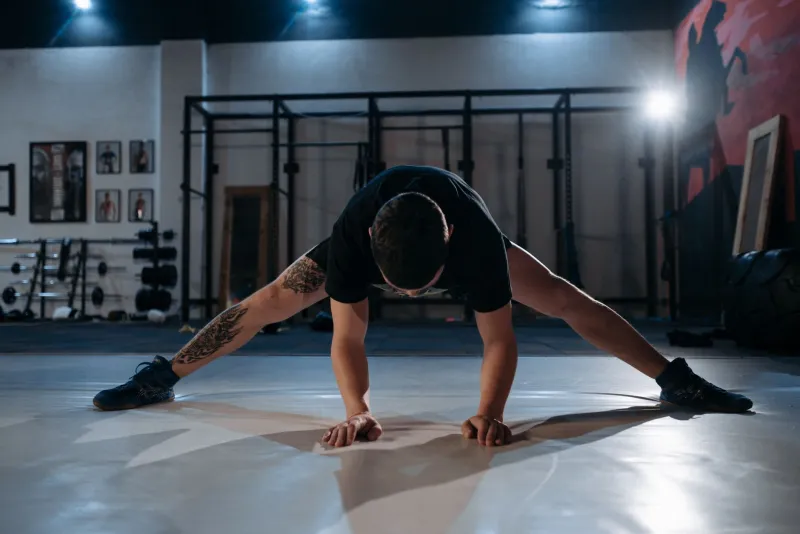
Planks and Core Work: This one trips people up. Don't hold your breath during isometric core exercises. Instead, breathe slowly and deliberately while maintaining your brace. Breathing during a plank actually trains your diaphragm and core to work together under load — which is exactly what you want.
Common Breathing Mistakes That Are Costing You
Breathing into your chest instead of your belly. Chest breathing (also called thoracic breathing) doesn't effectively increase IAP. You want to breathe into your belly — think about expanding 360 degrees, like you're inflating a balloon around your midsection. Your ribcage should move outward and your belly should push forward, not just your chest rising up.
Forgetting to brace before the movement starts. A lot of people breathe in and then immediately start moving. The brace — the active tension you create after the inhale — needs to happen before you initiate the lift. Breathe, brace, then move.
Exhaling too early on the descent. If you breathe out on the way down in a squat or deadlift, you're releasing pressure at exactly the wrong time. The descent is when your spine is under load and needs support. Hold your brace through the bottom.
Holding your breath for way too long on lighter sets. On high-rep work, you don't need to hold your breath for the entire set. Coordinate your breath with each rep — breathe in, brace, move, breathe out — and reset before the next one.
How to Train Your Breathing
Good news: you can practice this stuff without a barbell. In fact, starting without load is the best way to build the habit.
Try this simple drill: Lie on your back with your knees bent. Place one hand on your chest and one on your belly. Breathe in slowly through your nose — your belly hand should rise first, then your chest hand. Breathe out through pursed lips. Do this for 5 to 10 breaths before your next workout. It sounds almost too simple, but it recalibrates your breathing pattern and gets your diaphragm firing properly.
From there, apply the cues to your warm-up sets with light weight before you ever touch working loads. Breathing mechanics under 40% of your max is easy. Under 90%, it's a whole different story — and the only way to make it automatic under heavy load is to drill it when things are light.
The Payoff Is Real
A lot of lifters who start paying attention to their breath report feeling noticeably more stable and in control almost immediately. Not because their muscles got stronger overnight, but because they stopped bleeding force through a leaky system.
At Live Healthy Wellness Centre, we're big believers in the idea that moving better is often more valuable than moving more. You don't always need a new program, more volume, or a different exercise. Sometimes you just need to take a better breath.
So the next time you step up to the bar, don't just think about your feet, your grip, or your back angle. Think about your breath. Fill your belly, brace like you mean it, and move with intention. You might be surprised how much stronger you already are.