Good Posture Is a Myth — Here's What Your Body Actually Needs

We've all heard it. Maybe it was a parent tapping you on the shoulder at the dinner table, a gym teacher in middle school, or a chiropractor's poster in a waiting room. Stand up straight. Shoulders back. Chest out. The message has been drilled into us so thoroughly that most people associate "good posture" with rigid military alignment — a kind of physical virtue signal that means you're taking care of yourself.
Here's the uncomfortable truth: that version of posture is largely a fiction. Not only is it unsustainable, but actively forcing your body into that kind of locked-in position can restrict your movement, reduce your power output, and create the exact chronic tension it claims to fix.
Let's break down why — and what functional postural awareness actually looks like in real life.
The Problem With "Perfect" Alignment
Conventional posture advice tends to treat the human body like a building — stacked blocks that need to be perfectly vertical or the whole thing falls apart. But your body isn't a building. It's a dynamic, constantly adapting system of muscles, joints, connective tissue, and nervous system feedback loops.
When you force yourself into a rigid "correct" position, a few things happen. First, you're relying on static muscle contraction to hold that shape rather than letting your body find natural equilibrium. That sustained contraction leads to fatigue — fast. Second, you're often overriding your nervous system's own postural calibration, which is actually pretty good at figuring out efficient positioning when you let it.
Research in motor control has consistently shown that postural variability — the small, constant micro-adjustments your body makes — is a feature, not a bug. People with less postural variability, meaning those who hold themselves in a more rigid, fixed position, tend to experience more musculoskeletal pain over time, not less.
So when you're white-knuckling your shoulder blades together and bracing your core like you're about to take a punch, you're not building resilience. You're building tension.
Why Rigid Posture Kills Your Power
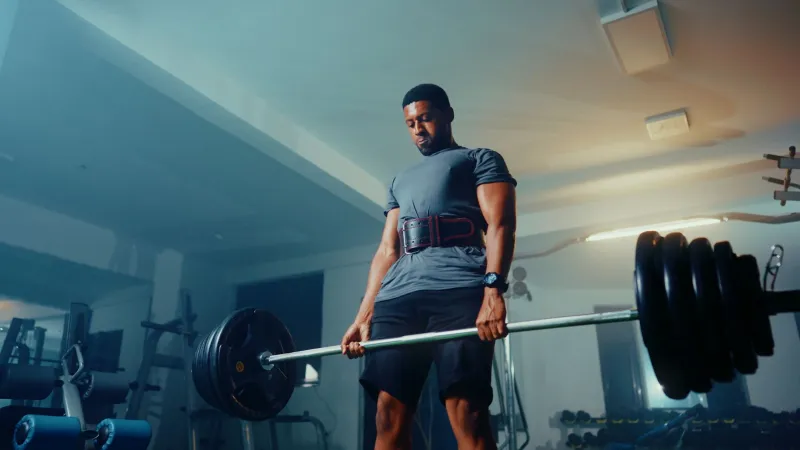
This really shows up in athletic performance. Power generation — whether you're deadlifting, throwing a baseball, or sprinting — depends on the kinetic chain moving fluidly and sequentially. Energy travels from the ground up through your feet, ankles, knees, hips, spine, and out through your arms or whatever limb is doing the work.
When any part of that chain is locked up, energy leaks. Think of it like a garden hose with a kink in it. You can have all the water pressure in the world, but if there's a rigid spot in the line, you're not getting full flow at the other end.
Coaches who work with elite athletes — from powerlifters to Olympic sprinters — talk about this constantly. The goal isn't a fixed neutral spine or perfectly retracted scapulae. The goal is available movement through a full range, with the ability to create tension when and where you need it, and release it when you don't.
Ironically, the person obsessively maintaining "textbook" posture during a squat is often the one bleeding power at the top and bottom of the movement, while someone with a more fluid, responsive positioning is moving more weight with less effort.
Body Type Changes Everything
Here's another piece of conventional posture advice that falls flat: it assumes everyone has the same skeleton. They don't.
Hip socket depth and angle varies enormously from person to person. Some people have hips that are built for a wide squat stance. Others do better with a narrower stance. Forcing someone with deep hip sockets into a narrow, toes-forward squat because it "looks right" is a recipe for impingement and pain.
The same goes for spinal curvature. Natural lumbar lordosis — the inward curve in your lower back — varies significantly between individuals and even between men and women on average. Trying to flatten that curve to match some ideal "neutral spine" diagram may actually be pulling someone out of their neutral, not into it.
Femur length, thoracic mobility, shoulder anatomy — all of it affects what good positioning looks like for a given person. A movement coach worth their certification isn't looking at you through the lens of a textbook diagram. They're watching how your body moves and finding the positions where you're strongest, most efficient, and least likely to get hurt.
What Functional Postural Awareness Actually Looks Like
So if rigid alignment is out, what's the alternative? It's not slouching on the couch indefinitely and calling it "postural variability." It's developing a more dynamic, responsive relationship with how you carry yourself.
Here's a simple framework to start with:
1. Find your stacked position, not a forced one. Instead of pulling your shoulders back hard, try this: take a big breath in, let your rib cage expand, and as you exhale, let your shoulders settle naturally. Notice where they land. That's closer to your actual neutral than any forced retraction.
2. Prioritize hip mobility over lumbar control. A lot of the postural dysfunction people experience in their lower backs is actually a hip mobility issue. When your hips can't move freely, your lumbar spine compensates. Spend time on hip flexor length and hip rotation — your lower back will thank you.
3. Let your core work dynamically, not statically. Your core isn't meant to be permanently braced. It's meant to respond — stiffening when you need stability, releasing when you need mobility. Practicing movements that require your core to turn on and off (think: carries, single-leg work, rotational exercises) builds more functional stability than holding a plank for three minutes.
4. Move positions frequently. The best posture is your next posture. If you sit, stand periodically. If you stand, shift your weight. The goal isn't to find one perfect position and stay there — it's to keep your body moving through variety.
5. Get assessed, not just advised. If you're dealing with chronic tension, pain, or movement limitations, a session with a qualified physical therapist or movement coach who does actual hands-on assessment is worth far more than any generic posture checklist. They can identify your patterns and help you work with your anatomy, not against it.
The Bigger Picture
Chasing perfect posture is, in a lot of ways, a symptom of our culture's obsession with optimization — the idea that if we can just get all the variables right, we'll be pain-free, powerful, and performing at our peak. But the body doesn't work like a machine you can tune to factory settings.
What it responds to is movement, variety, progressive load, and awareness. Not rigidity. Not performance. Awareness.
When you stop trying to look like the posture diagram on a chiropractor's wall and start actually listening to how your body moves, loads, and recovers — that's when things start clicking. Your lifts feel smoother. The chronic tightness in your upper traps starts to ease up. You stop bracing against your own body and start working with it.
That's what moving better actually feels like. And it looks a lot less like a soldier standing at attention than most of us were taught to believe.